Figures UCI sector 4th quarter 2025
16 June 2026 - 11 min Reading time
“The Belgian fund market grew by 3.3% during the fourth quarter of 2025, driven primarily by net inflows, supported by price gains in the underlying assets. As a result, the Belgian fund market reached a total marketed volume of €338 billion — a record high.”
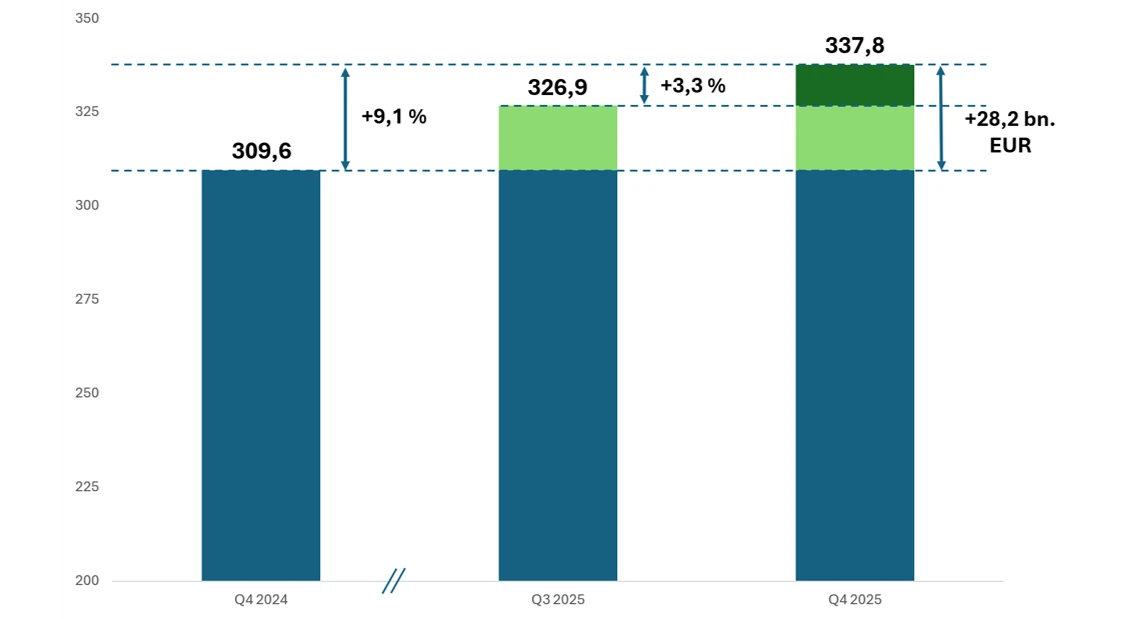
The Belgian fund sector recorded growth of +3.3% during the fourth quarter of 2025, mainly driven by net inflows, complemented by price gains in the underlying assets. By the end of December 2025, the net assets of publicly distributed funds in Belgium amounted to €337.8 billion.
- The net assets of funds investing primarily in non-fixed income assets, such as mixed funds and equity funds, increased by +3.9% over this period. During the fourth quarter of 2025, equity funds recorded the largest absolute increase in net assets. Within the mixed fund category, pension savings funds grew by 3.3% compared to the situation at the end of September 2025.
- The net assets of funds investing primarily in fixed income assets rose by 0.9% during the fourth quarter of 2025.
Funds investing in non-fixed income assets recorded both net inflows and price gains in their underlying assets during the fourth quarter.
Funds investing in fixed income assets also attracted net inflows, although these were partly offset by price decreases in their underlying assets during the fourth quarter.
Full year
At the end of 2025, the net assets of publicly distributed funds in Belgium stood at €337.8 billion. The Belgian fund sector saw a decline in net assets in the first quarter of 2025, entirely due to price losses in the underlying assets. In the following three quarters, net assets increased each time. In the second and third quarters, price gains were the main driver, while in the fourth quarter net inflows were the key factor.
Over the full year, net assets of publicly distributed funds in Belgium were 9.1%, or €28.2 billion, higher at the end of December 2025 compared to the end of 2024, with 60% of this increase attributable to net inflows.
Outlook for the first quarter of 2026
Preliminary indications for the first quarter of 2026 point to a slight decline in the net assets of the Belgian fund sector.
Belgian fund market
The Belgian fund market is defined as “the publicly distributed net assets of funds in Belgium, under both Belgian and foreign law”. BEAMA reports on all share classes of public funds authorised for marketing in Belgium.
In accordance with the list of public collective investment undertakings on the FSMA website.
BEAMA’s analysis shows that the net assets of funds publicly marketed in Belgium rose by €10.9 billion, or +3.3%, during the fourth quarter of 2025, bringing total assets to €337.8 billion at the end of December 2025.
The increase in the Belgian fund market between October and December 2025 is mainly explained by net inflows, supplemented to a lesser extent by price gains in the underlying assets.
Sustained demand for funds demonstrates Belgian investors’ strong confidence in these products. Traditionally, Belgian investors also pay close attention to the opportunities and trade-offs between different savings and investment options.
The development of the Belgian fund market in 2025—largely composed of internationally diversified investment portfolios—cannot be separated from the global economic environment and prevailing geopolitical tensions.
Throughout 2025, global inflation trends remained favourable, supported by falling energy prices and further normalisation of economic conditions. Central banks, including the ECB and the Fed, continued their path of gradual interest rate cuts. Although the pace of cuts slowed slightly in the fourth quarter due to renewed inflation concerns, overall market sentiment remained positive, with the scenario of a soft landing for the global economy largely materialising.
Despite occasional periods of volatility, financial markets maintained strong momentum throughout 2025. Following a robust third quarter—driven by solid corporate earnings, continued strength in the technology sector and the Fed’s rate cut in September—global equity markets also showed resilience in the final months of the year. Emerging markets experienced a mixed fourth quarter but benefited over the full year from earlier weakness in the US dollar.
Bond markets enjoyed one of their stronger years in recent times, driven by declining long-term interest rates. Both US core bond indices and European bond indices consolidated their gains in the fourth quarter, allowing both investment-grade and high-yield segments to end the year with solid positive results.
This combination of a more accommodative monetary policy, improved market dynamics and sustained demand for both fixed income and non-fixed income instruments resulted in an excellent overall performance for the Belgian fund market. Net inflows into bond, equity and mixed funds remained strong through to year-end.
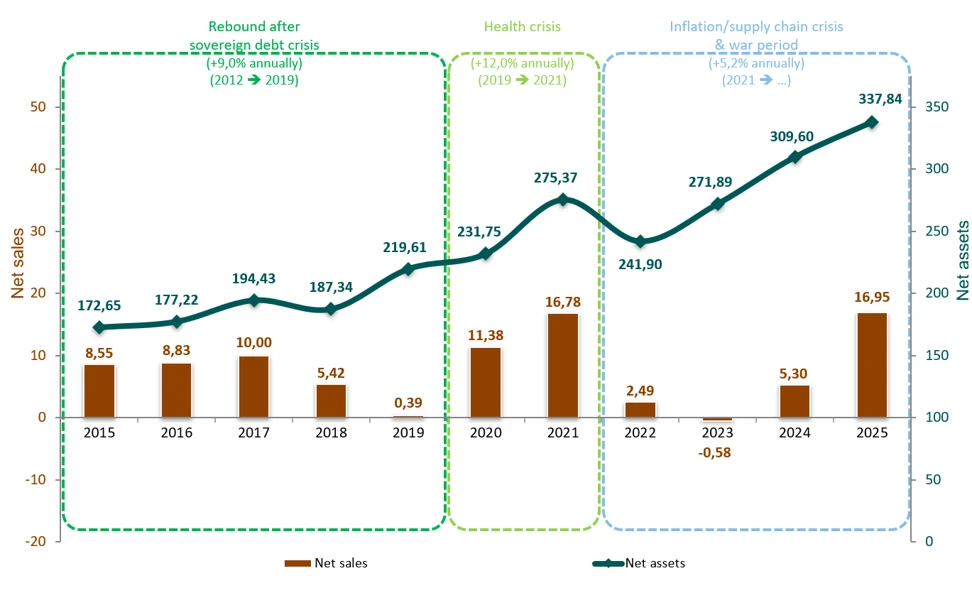
The strong growth of the Belgian fund market over 2025 is ultimately attributable to the rebound in global equity and bond markets in the final three quarters of the year, more than offsetting the weaker start to the year. As a result, most asset classes delivered positive returns in 2025.
Overall, the Belgian fund sector grew by €28.2 billion, or +9.1%, in 2025. Around 60% of this increase was driven by net inflows, with the remaining 40% attributable to price gains in the underlying assets. These figures are also confirmed by data from the National Bank of Belgium.
Preliminary indications available to BEAMA for the first quarter of 2026 point to a slight decline in net assets in the Belgian fund sector.
Funds primarily investing in non-fixed income assets
Within the group of funds primarily investing in non-fixed income assets (such as equity funds), only upward trends were recorded during the fourth quarter of 2025. These increases were driven by significant net inflows, complemented by price gains in the underlying assets.
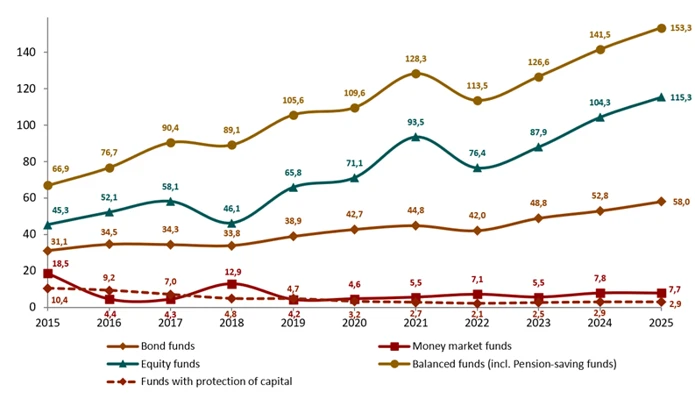
Assets held in Belgium in equity funds increased by €5.3 billion, or +4.8%, over the period October–December 2025. Around 80% of this increase is attributable to net inflows, with the remaining 20% resulting from price gains in the underlying assets. By the end of December 2025, equity funds accounted for €115.3 billion in assets.
The category of mixed funds (including pension savings funds) recorded an increase of €4.7 billion, or +3.2%, during the fourth quarter of 2025. This increase was driven by net inflows of €3.0 billion (65%) and price gains in underlying assets (35%). As a result, total marketed assets in mixed funds reached €153.3 billion at the end of December 2025.
Mixed funds have gained increasing popularity in recent years and have been the largest asset class since 2015. Thanks to their active asset allocation, they are particularly well suited to risk diversification strategies under MiFID II, allowing products to be aligned with clients' risk profiles.
Within the mixed fund category, pension savings funds increased by €0.9 billion, or +3.3%, during the fourth quarter of 2025. By the end of December 2025, pension savings funds represented €28.3 billion in net assets. During the fourth quarter of 2025, they recorded net inflows of €70 million.
Funds with capital protection also recorded an increase during the fourth quarter of 2025, reaching €2.9 billion in assets by the end of December 2025.
Over the full year 2025, the net assets of funds primarily investing in non-fixed income assets increased by +9.3%, or €23.1 billion.
Funds primarily investing in fixed income assets
Within the group of funds primarily investing in fixed income assets, assets in bond funds marketed in Belgium increased by €0.6 billion, or +1.0%, during the fourth quarter of 2025, reaching €58.0 billion at the end of December 2025. This increase was entirely driven by net inflows.
Net assets of money market funds recorded a slight increase of €0.05 billion, or +0.6%, between October and December 2025, driven by net inflows, reaching €7.7 billion by the end of 2025.
Over the full year 2025, net assets of funds primarily investing in fixed income assets increased by +8.5%, or €5.1 billion.
Sustainable funds
The table below provides an overview of the distribution of sustainable funds (according to the SFDR classification) in Belgium as at the end of December 2025 (only in Dutch).
SFDR = Sustainable Finance Disclosure Regulation.
Artikel 8 = producten die duurzaamheidskenmerken promoten;
Artikel 9 = producten met een duurzame doelstelling.
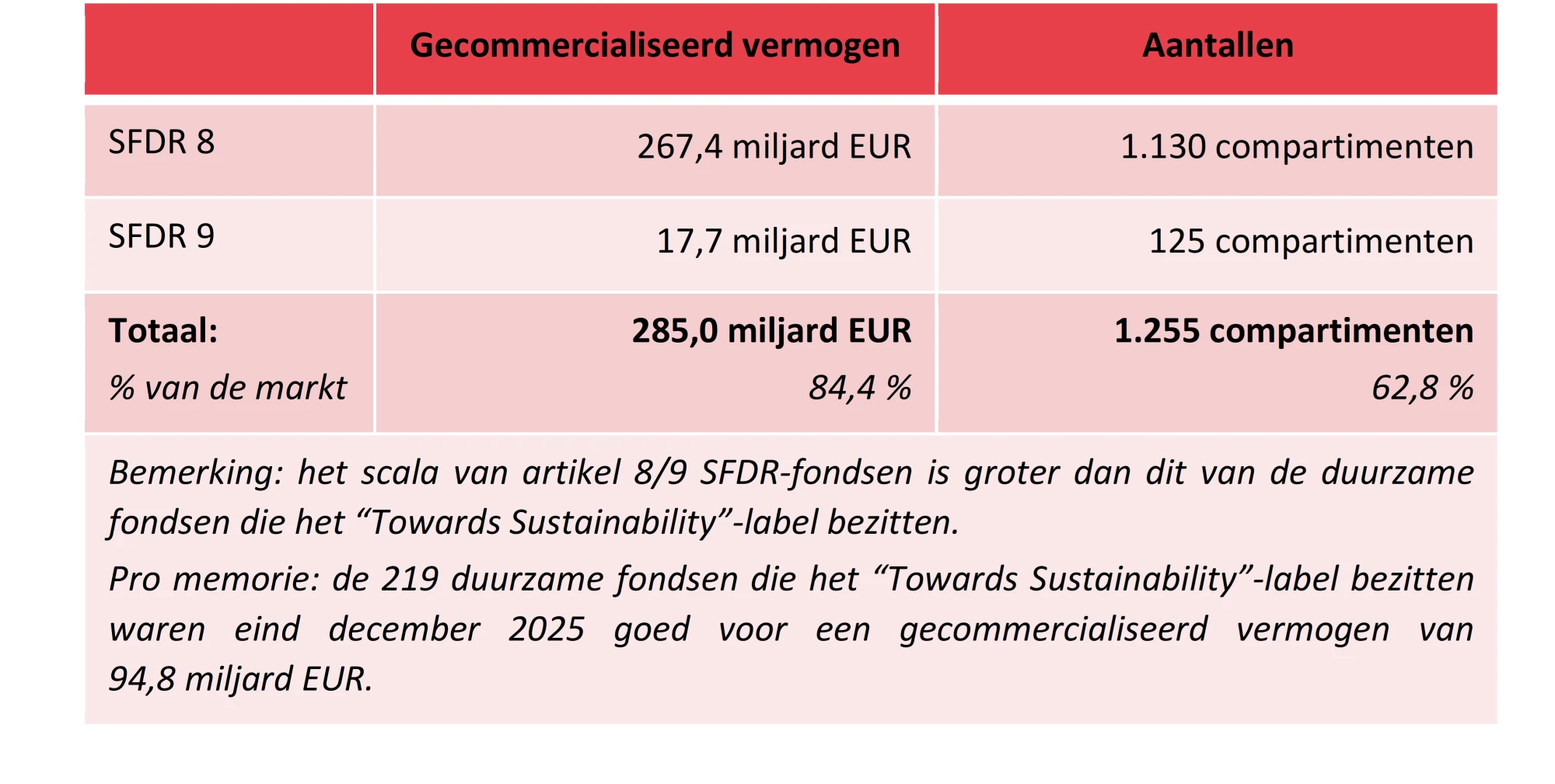
More than four-fifths of the assets distributed in Belgium are classified by asset managers as SFDR Article 8 or Article 9 funds. Investors seeking a certain level of sustainability can choose from 1,255 different funds.
Funds under Belgian law
Publicly distributed funds under Belgian law
ublic funds under Belgian law accounted for total net assets under management of €247.0 billion at the end of December 2025. At that time, pension savings funds represented 11.6% of public funds under Belgian law.
The calculation of the average annual return of pension savings funds as at 31 December 2025 yields the following results:
1 year: +7.5%
3 years: +7.5%
10 years: +3.3%
25 years: +4.3%
BEAMA has developed a dashboard for pension savings funds, which is attached to this press release. This dashboard provides a concise quarterly visual overview of key figures relating to the third-pillar pension savings funds and their evolution.
Not publicly distributed institutional funds under Belgian law
Since the Royal Decrees implementing the framework—published in the Belgian Official Gazette on 18 December 2007—investment vehicles tailored to institutional investors can be developed in the form of “institutional UCIs with a variable number of units”. These institutional funds are not publicly distributed and must be notified to the FPS Finance.
These institutional funds should not be confused with public funds with non-retail share classes, which are notified to the FSMA.
At the end of December 2025, the 120 institutional compartments under Belgian law represented €35.6 billion in net assets. These funds appeal to many institutional investors, particularly as they contribute to the depth of institutional markets in terms of financial assets and pension provision.
More information
Further information can be obtained via BEAMA’s representation:
Mr. Marc Van de Gucht, Director General BEAMA (02 507 68 72 – marc.van.de.gucht@febelfin.be)
BEAMA services (info@beama.be)
These and other statistics relating to the UCI sector are available on the BEAMA website (https://www.beama.be/) under the “Statistics” section (only in Dutch/French).